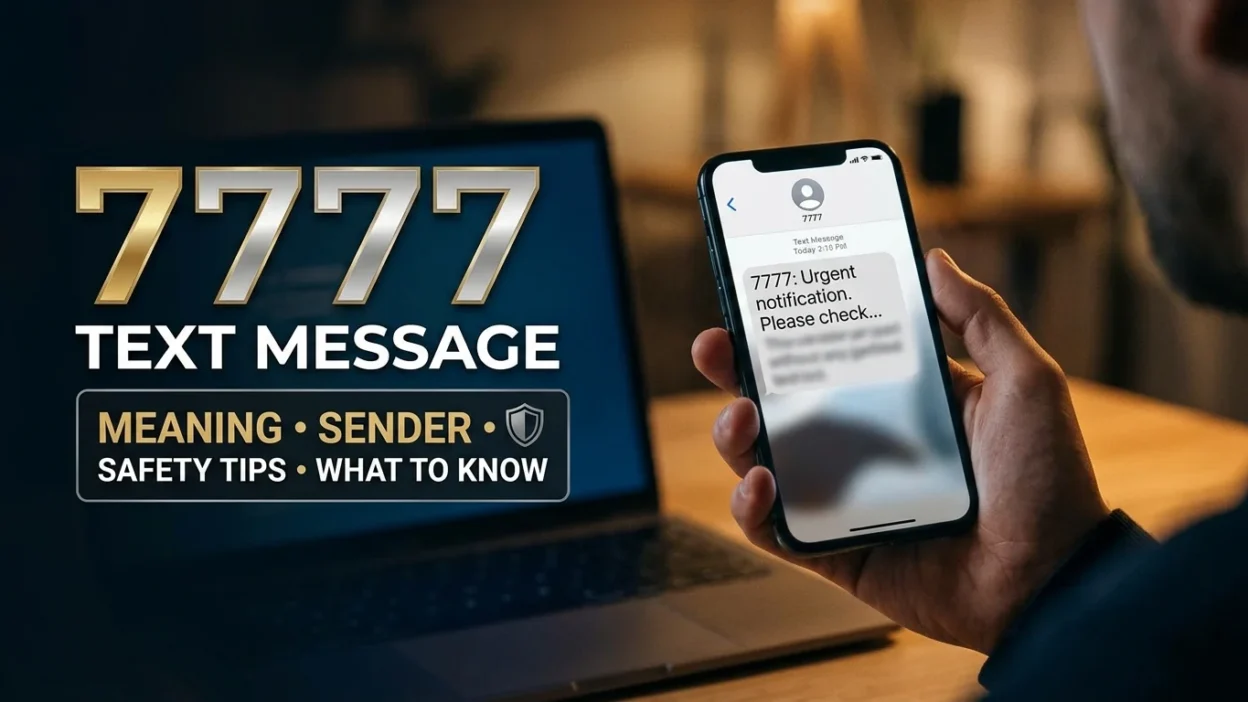
📱 You check your phone and see a text from 7777. It’s a short, repeating number that feels both familiar and confusing. Is it a legitimate service message, a promotional offer or a scam trying to steal your information? The answer isn’t simple because 7777 is not a single, universal short code. Instead, it has been used by different companies in different countries for completely different purposes. Sometimes it’s a legitimate way to subscribe to a service or check your account. Other times, scammers exploit the number’s recognizability to trick people into clicking malicious links.
This guide will walk you through the legitimate uses of the 7777 text message, explain the common scams associated with it and give you clear steps for handling any message you receive. By the end, you’ll know exactly how to tell the difference and what to do.
📌 Why 7777 Isn’t One Number Everywhere
The most important thing to understand about 7777 is that its meaning depends entirely on where you live and which mobile network you use. Unlike a short code that belongs to one specific brand (like a bank or a retailer), 7777 has been used by multiple telecom operators across different countries for various services over the years. Consequently, seeing 7777 on your screen tells you very little on its own. You need context—the content of the message and your location—to determine whether it’s legitimate.
In some cases, 7777 is a service code you actively use. In others, it’s a number scammers impersonate or reference in their fraudulent messages. The confusion is understandable, but the distinction matters for your security.
📲 Legitimate Uses of 7777 by Mobile Operators
Several telecom companies have historically used 7777 as a short code for customer services. These are legitimate, opt-in services, and messages from these numbers are usually safe.
TuneTalk (Malaysia): Data Plan Activation
In Malaysia, TuneTalk offered a daily data plan that users could activate by sending an SMS with the text “50MB” to 7777 . The service renewed automatically every day, and users could stop the subscription by texting “STOP” to the same number. They could also check their data usage by sending “STATUS” to 7777 . If you’re a TuneTalk customer and you signed up for this plan, messages from 7777 would be part of that service.
Telenor Pakistan: Friends and Family Management
Telenor Pakistan uses 7777 for managing its “Friends and Family” service . Customers can add a number to their Friends and Family list by sending an SMS with the word “Add” followed by a space and the phone number to 7777. The SMS itself is free, though there are charges for making calls to those numbers via USSD codes . This is a functional, legitimate service for Telenor subscribers.
Warid (Pakistan): Internet and Social Media Packages
Warid Telecom (which later merged with Mobilink/Jazz) extensively used 7777 as a subscription code for various internet and social media bundles. Customers could activate daily, weekly, or monthly data packages by sending codes like “2 MB,” “UL” (unlimited), or “WM” to 7777 . They also used the same number to subscribe to unlimited Facebook and WhatsApp offers by texting “FB” or “FW” . These were legitimate, paid services offered by the carrier.
Oskar (Czech Republic): Interactive SMS Services
In the Czech Republic, the operator Oskar (now Vodafone) used 7777 for “Active SMS” services . Customers could send coded messages to 7777 to vote in television competitions, receive horoscopes, get weather forecasts, or participate in discussions. Each message cost a fixed fee, and the service was a legitimate, paid offering .
🚨 The Scam Side: When 7777 Is Used for Fraud
While 7777 has legitimate uses, it has also appeared in various scams. Scammers exploit the fact that 7777 looks like a short code, hoping people will trust it without thinking.
Fake Prize and Gift Card Offers
One of the most common scams involves a text message claiming you’ve won a prize, like a $1,000 Best Buy gift card, and that you need to enter a code (sometimes “7777”) on a website to claim it . Users have reported receiving these messages from random phone numbers, not from the short code 7777 itself. The scam uses the number as part of the lure, but the message comes from a spoofed or unrelated number.
Fake Bank Alerts (Thailand)
In Thailand, a sophisticated scam involved messages that appeared to come from Siam Commercial Bank (SCB) . The scammers spoofed the bank’s actual call center number, which ends in 7777, to make the messages look legitimate. The texts claimed the user needed to “upgrade their system” and directed them to a fake website to enter personal information. SCB confirmed that it does not send SMS messages asking customers to fill in personal data . This case highlights how scammers can misuse a legitimate number’s reputation.
The Common Thread: Urgency and Links
Across all these scams, a few warning signs appear repeatedly. The messages create a sense of urgency (“only the first 1000 users,” “immediate upgrade required”). They include links to click. And they ask for personal information or payment details. Legitimate service messages from 7777 (like Telenor’s or TuneTalk’s) are usually functional—they confirm a subscription, provide a balance, or give instructions you requested. They don’t pressure you to click unknown links.
🛡️ How to Protect Yourself When You See 7777
If you receive a message from or mentioning 7777, here’s how to handle it safely.
Check If You’re a Customer of the Relevant Service
If you’re in Pakistan and use Telenor, a message from 7777 might be about your Friends and Family list . If you’re in Malaysia and use TuneTalk, it could be about your data plan . If you’re not a customer of any service that uses 7777, the message is more likely to be suspicious.
Never Click Links in Unexpected Messages
This is the golden rule for all text scams. If a message from 7777 or any other number asks you to click a link, don’t do it. Go directly to the official website or app of the company it claims to be from. Type the address yourself.
Don’t Reply with Personal Information
Legitimate service messages don’t ask for your password, ID number, or banking details via SMS. If a message requests this information, it’s a scam. Reply “STOP” only if you’re certain it’s a legitimate marketing message you want to end, but never reply with sensitive data.
Report and Delete
If you receive a suspicious message, report it to your carrier (in many countries, you can forward spam to 7726) and then delete it . Don’t engage further.
❌ Common Mistakes to Avoid
When dealing with 7777 messages, avoid these errors.
Mistake 1: Assuming All 7777 Messages Are Scams
If you’re a Telenor or TuneTalk customer, a 7777 message might be a legitimate confirmation of a service you used. Don’t dismiss it automatically without checking the content.
Mistake 2: Assuming All 7777 Messages Are Legitimate
Conversely, don’t trust a message just because it uses 7777. Scammers spoof numbers and reference codes to build false credibility. Always verify through official channels.
Mistake 3: Replying STOP to a Scam
While “STOP” works for legitimate marketing messages, replying to a scam message confirms your number is active. For suspicious messages, don’t reply at all—just report and delete.
❓ Frequently Asked Questions
Is 7777 a scam number?
It can be, but not always. 7777 is a legitimate short code used by mobile operators like Telenor Pakistan and TuneTalk Malaysia for specific services . However, scammers also use the number or reference it in fake prize and bank messages. The context of the message determines whether it’s safe.
Why did I get a text from 7777?
If you’re a customer of a service that uses 7777 (like Telenor’s Friends and Family or a TuneTalk data plan), the message is likely a service confirmation. If you’re not, it’s more likely to be spam or a scam. Check the content for details about a service you recognize.
What does 7777 mean spiritually?
In numerology and angel number interpretations, 7777 is often seen as a sign of spiritual awakening, intuition, and perseverance . However, this is unrelated to text messages. If you’re seeing the number everywhere, it’s a spiritual concept, not a message from your phone.
How do I stop receiving messages from 7777?
If it’s a legitimate marketing or service message, you can usually reply “STOP” to opt out (TuneTalk explicitly offered this option) . If it’s a scam, don’t reply—report and delete.
Can I trust a 7777 message about my bank?
Be very cautious. In Thailand, scammers spoofed a bank’s real 7777 number to send fake upgrade alerts . Never click links in bank messages. Always log into your bank’s official app or website directly.
What should I do if I clicked a link in a 7777 scam message?
If you clicked but didn’t enter information, clear your browser and monitor your accounts. If you entered personal or financial details, contact your bank immediately and change any compromised passwords.
✅ Conclusion
The 7777 text message is a number with two faces. On one side, it’s a functional short code used by mobile operators in countries like Pakistan, Malaysia, and the Czech Republic for legitimate services like data plans, friend lists, and interactive SMS . On the other side, it’s a number scammers exploit, referencing it in fake prize offers and spoofing bank alerts to steal personal information . The key to staying safe is context. If you’re a customer of a service that uses 7777, verify the message content before acting. If you’re not, treat it with suspicion. Never click unexpected links, never share personal information via text, and always verify through official channels. With this approach, you can handle any 7777 message confidently and keep your information secure.

Mr. Abdullah is a passionate writer who creates engaging, helpful, and easy-to-understand content for readers. He enjoys sharing fresh ideas, useful insights, and inspiring stories through MessageWritingHub.